AI governance controls framework
AlignAI ships with a base control template derived from the NIST AI Risk Management Framework and ISO 42001, rather than requiring you to build a controls library from scratch.
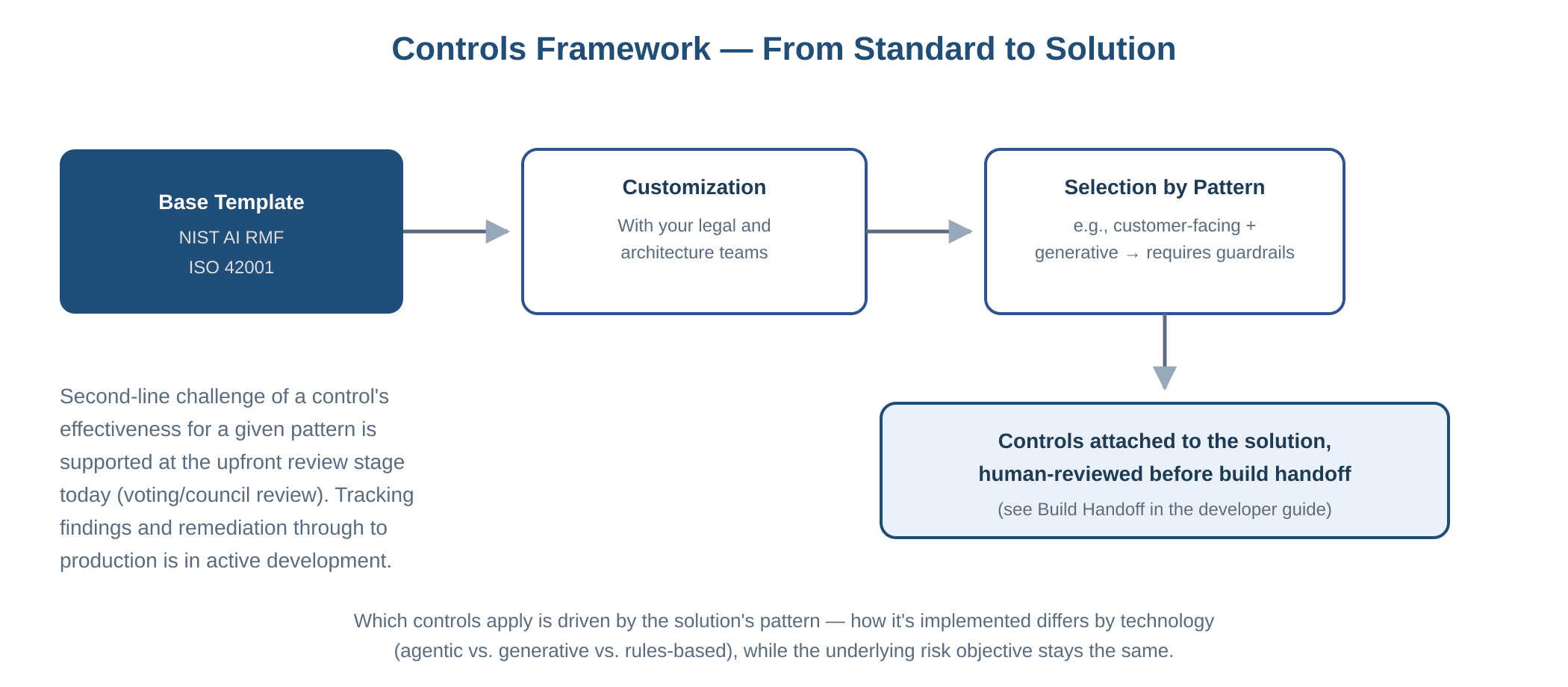
- Base template. The starting point is built from NIST AI RMF and ISO 42001, reflecting established best practice rather than a blank slate.
- Customization. AlignAI works with your legal and architecture teams to adapt the base template to how your organization actually wants to define and enforce controls.
- Selection by pattern. Which controls apply to a given use case is driven by its solution pattern and target architecture — a customer-facing generative solution and an internal rules-based automation don’t carry the same control set, even if the underlying risk objective (e.g., preventing unauthorized disclosure) is the same. This keeps the control logic granular enough to say precisely which controls apply to which kind of solution.
- Human review before build handoff. Selected controls are reviewed and approved by a person before they’re handed to the development team as part of the build handoff (see the developer guide for that mechanism).
Second-line challenge of control effectiveness. Upfront review — including multi-person voting/council review — supports a second-line reviewer challenging whether a control set is adequate for a given use case, even one that otherwise fits an already-approved pattern. Carrying that challenge, and the resulting decision, through to a tracked finding and remediation on the way to production is an area of active development rather than a shipped, general-availability capability today — worth confirming current status directly if downstream findings-tracking is a hard requirement for your rollout timeline.